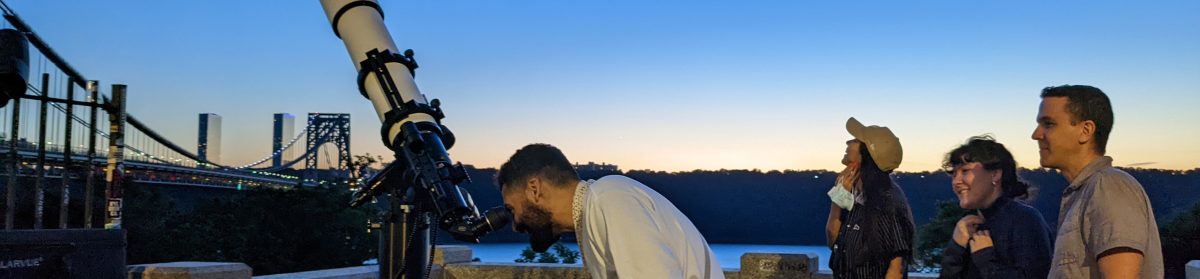

Never point a telescope or binoculars at the sun — unless you have a proper solar filter and know what you’re doing. Matt and I each have solar filters for our telescopes, and know how to manage solar astronomy safely. And so we had a fun time at Wellfleet Pier during the day, rather than our usual nighttime outreach, along with some folks who passed by.
Through my telescope with its basic white light filter, we could see the sun’s disk and a speckling of sun spots. These are little knots of intense magnetism on the solar surface, which block some heat flow from below. The spots are still hot (6740 degrees) but significantly cooler than the surrounding surface (9950 degrees); thus they appear darker. They’re also huge: a sunspot can be the size of Earth or larger. And they’re temporary features, coming and going with solar activity, and rotating with the sun, making a circuit in about 26 days — if the magnetic knot lasts that long.
Matt has a hydrogen-alpha filter for his telescope. This much more complicated filter presents the sun in a deep red color, a wavelength emitted by hydrogen atoms as they transition to a lower energy state. In hydrogen-alpha you can see stunning solar prominences along the sun’s limb: enormous fountains of plasma arcing up from the surface, following magnetic field lines, and cascading back down.
You can see a prominence that was visible at totality during the total solar eclipse in April in a photo from my post about seeing the eclipse.


