
On April 8, the day of the Great North American Solar Eclipse of 2024, I drove 6 hours to a park in Westport, New York, by Lake Champlain. The lake and mountains beyond were a beautiful sight on their own and a proper setting for the spectacle of totality. Hundreds of other people seemed to agree; the park was crowded.
Days before the sheriff of an upstate county had warned in a press conference that he expected hundreds of thousands of people on the move on April 8, converging on the path of totality. And that was just New York. Some official estimates had predicted millions would be traveling across North America to intercept the narrow, 122-mile shadow of the Moon as it sped from western Mexico to eastern Canada at over 1000 miles per hour.
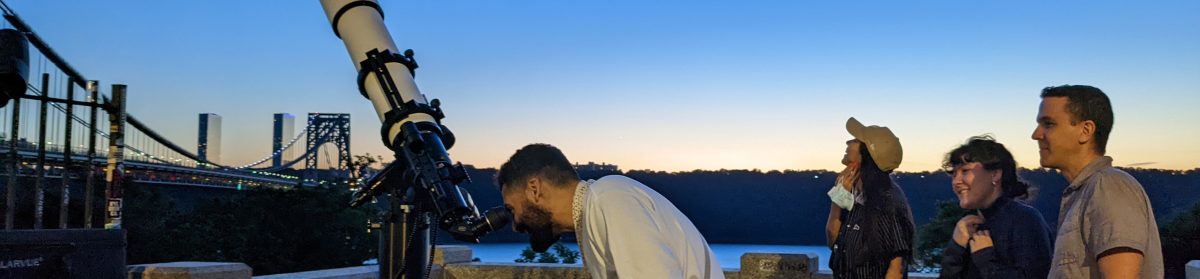
As a street astronomer, I’ve set up my telescope at beaches and piers, in parks and backyards, and on urban and suburban sidewalks. I’ve set up for comets, conjunctions, transits, lunar eclipses, and partial solar eclipses. But I had never set up for such a special event – a total solar eclipse – nor among such a big crowd.
I was fortunate that day to be with close friends and family. I felt a camaraderie with the many strangers, as well.
That feeling had begun hours earlier as we clawed up our way up interstate 87. The drive felt like something out of a disaster movie: packed cars crowding the roads, everyone heading in the same direction (the opposing lanes were nearly empty), and the uneasy feeling that everyone around you was your competition.
But we were heading toward something wonderful, as opposed to fleeing zombies. And the other cars weren’t really our competition, though their presence slowed us (just as ours slowed them). Even as I gritted my teeth at our labored progress, I hoped the people in the other cars would make it to their destination in time. Like my companions and me, they were making the effort to see something special, taking time from work and personal obligations, spending money on fuel and tolls. My heart went out to the flat tires and surprisingly number of collisions at the side of road. But like in a zombie apocalypse, we could not stop to help; it would cost us the eclipse.
At the park by Lake Champlain, the feeling of camaraderie intensified. Everywhere I saw small groups of family and friends, most of them strangers to each other, mingling and talking. I felt the absurd urge to cheerfully greet everyone I saw like an exuberant three-year-old. It was like the friendly atmosphere outside the venue where your favorite band was playing. We were all there for the same show, all fans of the natural world that afternoon.
My friends took turns minding my dogs (thank you, Chris, Madison and Matty!) so I could set up the telescope. Once the solar filter was secure I had my nieces and brother-in-law look at the Sun. Then I invited nearby people to look. Others saw the growing line at the telescope and came over. And I stayed alert for anyone who showed interest but seemed hesitant to approach. We watched the Moon slowly devour the Sun and talked about how far we had traveled. Some lived in town or nearby. Others, like me, had come from far away.
Around us the light transformed, taking on a golden hue, then pale silver. Suddenly it was cold. Shadows took on sharp edges. I felt like I stood on a planet out of a science fiction movie.
Then it happened quickly. The Sun, a beautiful thin crescent in the telescope but still a blinding light in the sky, vanished. Something terrible and wonderful took its place. For the next two minutes and forty-eight seconds we could gaze with unprotected eyes at a dark sun set against a dark sky: the black disk of the Moon covering the Sun’s surface. Deep twilight fell. In all directions the horizon glowed red like sunset.
People shouted and cried out. The corona was visible, the Sun’s atmosphere, ghostly white tendrils of plasma surrounding a jet-black disk, beautiful and menacing.
Two minutes. I’m afraid, I thought, laughing to myself. I’m actually afraid.
One minute. I thought of my daughters at college in Ohio, directly under the path of totality, celebrating with their friends. My teenage son had declined to accompany me and was at school, outside totality. I regretted not insisting that he come along.
10 seconds. A chill wind blew from over the lake. “Look away!” I said. Others took up the warning. “Look away! Look away!”
All at once it ended. The dark sun went and the true Sun returned, familiar and blinding. We turned to each other, friends and strangers alike, laughing and smiling.
“Amazing. Beautiful. Terrifying. Wonderful.” But even as we said these words we shook our heads. None were quite right. There are no common references for totality; it is a singular experience.
The park slowly emptied as the world returned to normal. People waved goodbye to those they had just met. And so with the return of color and warmth the comradery of the day waned. The eclipse that had brought us all together had ended, and all that remained was the long drive home. And the memory of an experience beyond words, shared with a few hundred brief friends.


