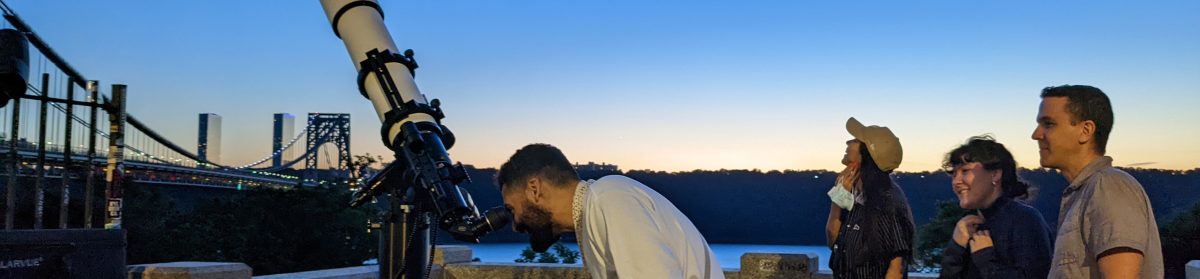
When I moved away from my neighborhood of 20+ years, I promised my many astronomy friends that I’d return. I was only moving a mile south. It would be easy to make a trip back every now and then with the telescope.
That promise was easily made but long in the keeping. 18 months after moving, I finally set up at my old haunt at the end of West 181 St. – and let everyone know I’d be there.
Thank you to all who were able to come out! It was great to see you all. And I’ll be back.
November is cruel for backyard telescope observers. The air can be so crisp and clear during the day: ideal conditions, after dark, for teasing detail out of small faint objects at the eyepiece. But as the sun sets, clouds roll up the horizon, a gloomy murk creeps over the zenith, and the wind gusts. Conditions deteriorate to the point of futility.
But fortune smiled upon the Navigators last night. My friend and neighbor leads a Navigators group (a co-ed scouting program focused on character, leadership, practical skills, and community service) for his son and several local kids. We had planned a night with the telescope some weeks before, based on our busy schedules and the lunar cycle. The big variable was the weather.
The day was (of course) crisp and clear. As sunset approached, conditions (of course) deteriorated. But not to the point of futility. A bright, nearly full moon can punch through haze and even wispy, tattered, fast-moving clouds, conditions which dominated the sky. For many of the kids (and parents) it was their first view through a telescope, and the moon amazed and delighted them. I talked with the kids about how a telescope works and the lunar features they can see with the unaided eye (maria and highlands) and with the telescope (craters, mountains, ridges and valleys, deep shadows and bright peaks rising above darkness and catching the sunlight).
While the kids and parents looked through the telescope, I scanned the sky around the moon. Saturn was there, somewhere. But the streaming clouds obscured it. Finally a clear patch of sky opened up and there it was: a modestly bright, red-gold star near the moon. I swung the telescope around, centered it on Saturn, and told everyone we were in luck. And that the clock was ticking; the opening wouldn’t last long.
Everyone got a look at Saturn and its rings, even though it isn’t the best time to see them. Right now from our point of view the rings appear nearly edge-on, a narrow band across Saturn. The apparent tilt oscillates on an approximately 15-year cycle as Earth comes into and out of alignment with the plane of Saturn’s rotation. We’re just past the most recent edge-on alignment. Over the next 7 or so years the rings will “open up” into a wide arc across the planet’s face. It’s a breathtaking sight and one that always causes first-time observers to shout out loud when I invite them to look through my telescope.
For kids and parents seeing Saturn’s rings for the first time, the narrow tilt didn’t matter; there were still shouts of excitement and disbelief. And for the next 7 years the rings will just get better and better.